Generative AI
The Future of Workplace Productivity
March 6, 2026

Something interesting is happening in workplaces right now. The conversation has shifted. We're no longer debating whether AI will replace humans. Instead, we're watching a new competition unfold, one between professionals who work with AI and those who don't.
Think about it. Two equally talented people walk into an office. One knows how to leverage AI tools effectively. The other doesn't. Who do you think will deliver better results faster? The answer is becoming increasingly clear, and the data backs it up.
Let's talk about what's really happening in 2025. Organisations worldwide report AI adoption rates hovering between 72% and 78%. That's not just hype, it's mainstream adoption.
Workers who use generative AI are saving about 5.4% of their work hours, according to the Federal Reserve Bank of St. Louis research from February 2025. Now, 5.4% might not sound revolutionary at first, but when you translate that across entire workforces, you're looking at a 1.1% productivity increase. And here's the thing, we're just getting started.
The Penn Wharton Budget Model released an analysis in September 2025 showing that AI will boost productivity and GDP by 1.5% by 2035. By 2055, we're looking at nearly 3%, and by 2075, around 3.7%. The peak impact? That's coming in the early 2030s with about a 0.2 percentage point boost to annual productivity growth.
But here's where it gets really interesting. PwC research suggests artificial intelligence could supercharge employee productivity by 40% by 2035. Meanwhile, an IBM study from October 2025 found that 66% of surveyed enterprises in Europe, the Middle East, and Africa are already seeing significant operational productivity improvements.
These aren't predictions anymore. They're measurements of what's actually happening.
AI use at work has nearly doubled in just two years. According to Gallup's June 2025 study, 27% of white-collar employees now use AI frequently, which is up 12 percentage points since 2024.
Get this: 28% of U.S.-employed adults are using ChatGPT for work in 2025. That's double the rate from 2023. And among those users, 27% are saving over 9 hours per week. Some people, 18% of users, are saving more than 10 hours weekly. Imagine what you could do with an extra 10 hours every week.
But here's what concerns me. Leaders are twice as likely to use AI frequently compared to individual contributors, 33% versus 16%. That's a significant gap, and it represents a real opportunity being missed by many workers.
The adoption varies wildly by industry, too. Technology companies are leading at 50%. Professional services sit at 34%. Finance is at 32%. If you're in one of these sectors and not using AI, you're already behind your peers.
Globally, AI tools now reach 378 million people worldwide in 2025. That's 64 million new users added since 2024 alone. We're watching a fundamental transformation in how humans work.
Let me show you what this looks like in practice.
Healthcare has embraced AI with a 36.8% compound annual growth rate in adoption. Walk into 42% of major healthcare networks today, and you'll find AI-powered chatbots handling initial patient inquiries. This frees up medical staff for what they do best, complex care that requires human judgment.
Doctors aren't being replaced. They're being empowered. AI helps with diagnostics and clinical documentation, but physicians still apply their expertise and make the final treatment decisions. It's a partnership, not a replacement.
AI systems now handle routine customer inquiries autonomously. Response times have dropped dramatically. But when things get complicated, when empathy matters, when the situation is nuanced, human agents step in. The result? Customers get faster service and better outcomes.
Financial services companies process massive amounts of market data using AI algorithms. They do it instantly. But the strategic thinking? The experience-based judgment? That still comes from human traders and analysts. This combination has revolutionised how financial institutions operate.
IT and telecommunications companies hit a 38% AI adoption rate in 2025. This sector alone is projected to add $4.7 trillion in gross value through AI implementations by 2035. Network optimisation and customer experience applications are driving this growth.
Retail businesses now allocate 20% of their technology budgets to AI solutions. That's up from 15% in 2024. They're confident AI drives sales and enhances customer experiences, and they're putting their money where that confidence is.
Here's the uncomfortable truth. IBM's Global AI Adoption Index shows that 42% of organisations are already using AI. But only 46% of employees feel adequately supported with upskilling opportunities. That's a problem.
The World Economic Forum survey demonstrates something alarming: about 40% of core skills demanded by employers will change by 2030. And 45% of employers consider AI and big data skills to be core requirements now.
Want to know what's even more concerning? Analysis from OECD countries reveals that only between 0.3% and 5.5% of training courses currently deliver AI content. The gap between what workers need and what's being provided is massive.
Nearly 45% of US workers reported using AI in their jobs in 2025, but adoption rates vary dramatically across generations, industries, and genders. We're at risk of leaving huge segments of the workforce behind.
I've watched this unfold, and certain patterns emerge among people who succeed with AI.
First, technical literacy matters. You don't need to be a programmer, but you need to understand how AI works, where it fails, and when you should trust its outputs. Prompt engineering, knowing how to ask AI the right questions, has become a legitimate skill.
Second, critical thinking is more important than ever. AI can generate insights all day long. But someone needs to interpret them, apply context, and consider ethical implications. That someone is you.
Third, adaptability is non-negotiable. Skill change in AI-exposed jobs is accelerating from 25% last year. If you're not comfortable with continuous learning, you're going to struggle.
Finally, emotional intelligence remains uniquely human. AI excels at processing data. It fails at empathy, situational awareness, and nuanced human understanding. These skills set successful workers apart.
Revenue growth in AI-exposed industries has accelerated sharply since 2022, the year ChatGPT 3.5 launched. Companies positioned to leverage AI have seen their value creation skyrocket.
Here's something fascinating: wages are rising twice as quickly in industries most exposed to AI compared to those least exposed. Workers with AI skills command a 43% wage premium compared to workers in the same job without AI skills.
Even in highly automatable roles, wages are rising for AI-powered workers. AI isn't making workers cheaper, it's making them more valuable.
Large enterprises report better results than smaller companies (72% versus 55% seeing productivity gains), but small and medium businesses are figuring it out too.
Let's be clear about something. AI is powerful, but it's not magic.
Creativity, ethical reasoning, emotional intelligence, and the ability to navigate ambiguous situations remain human territories. OECD research shows that individuals in customer support, software development, and consulting have seen productivity gains ranging from 5% to over 25%. Interestingly, less-experienced or lower-skilled individuals tend to see the largest gains.
AI is an equaliser. It lifts people. But it doesn't replace the fundamentally human aspects of work.
Economic research over several decades confirms something important: large productivity gains happen when new tools strengthen workers' skills, judgment, and creativity within supportive organisations. Companies that just slap AI onto existing processes see minimal gains. Those that reorganise work, upskill employees, and redesign workflows around human-AI collaboration? They see dramatic improvements.
Here's the dark side nobody talks about enough. 88% of top AI users report significant stress and burnout. The people getting the best results with AI? They're actually twice as likely to consider leaving their jobs due to burnout.
71% of full-time employees using AI report burnout driven by increased workloads. And 47% of AI users are unclear on how to achieve expected productivity gains.
This isn't sustainable. Organisations need to provide clear guidance, reasonable expectations, and robust support systems. The goal isn't to work faster forever. It's to work smarter, allowing humans to focus on high-value activities while AI handles routine tasks.
Companies that ignore the human cost of AI adoption will face talent retention challenges that completely undermine any productivity gains they achieve.
AI's impact on productivity growth is small right now, just 0.01 percentage points in 2025. Most businesses haven't fully deployed AI tools yet. But this will change rapidly as tools improve, adoption increases, and more sectors integrate the technology.
By 2027, AI will boost productivity growth by 0.09 percentage points. By 2030, it'll be 0.18 percentage points. The peak comes in the early 2030s at around 0.2 percentage points.
Consider this: two years after ChatGPT's release, overall AI adoption rates are nearly double those of personal computers three years after the IBM PC's 1981 release. We've never seen technology adoption this fast.
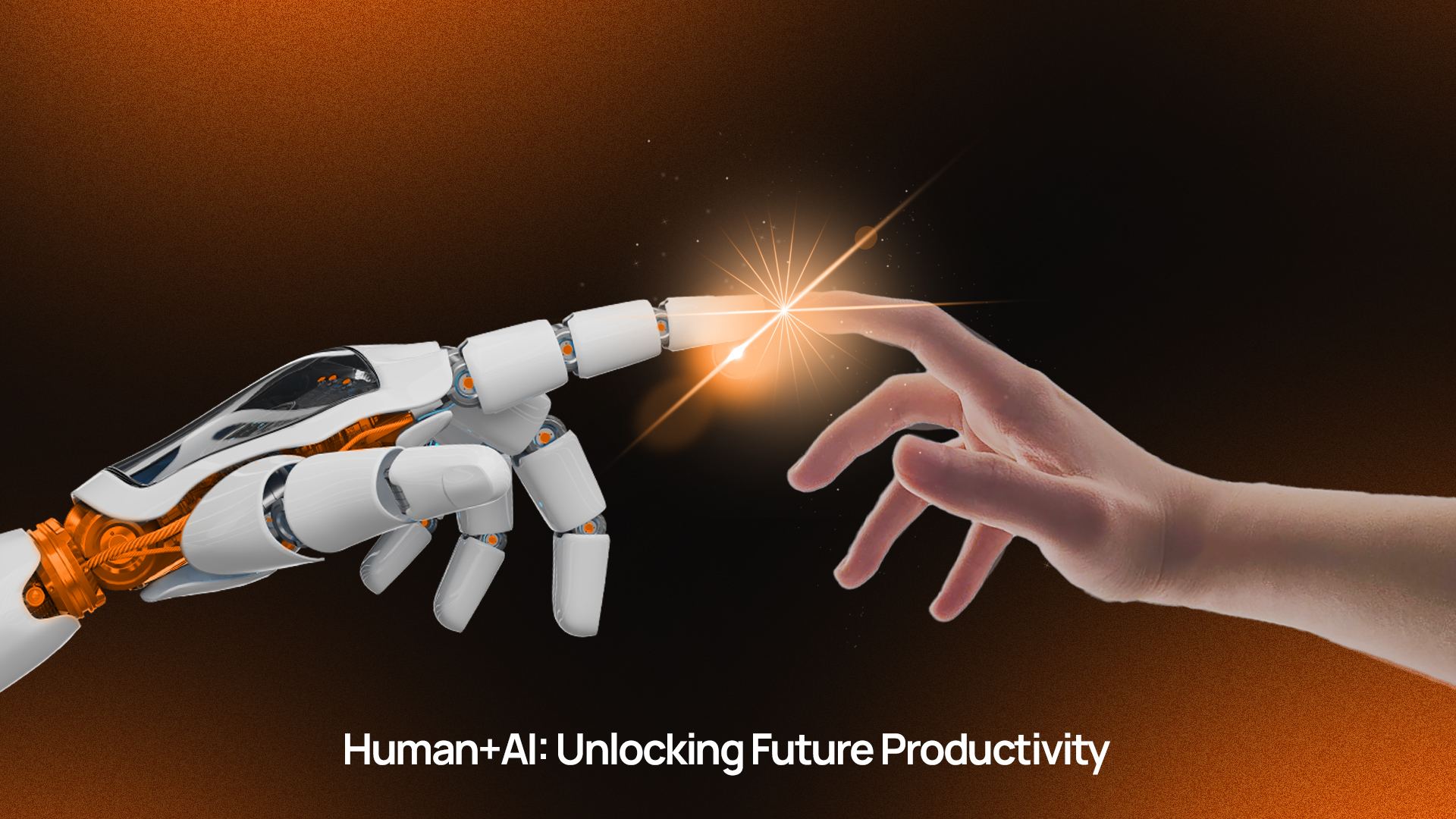
The future doesn't belong to AI alone, and it doesn't belong to humans working without AI. It belongs to those who master the partnership.
The most successful professionals and organisations view AI as a collaborator that amplifies human capabilities, not as a replacement. Only 16% of employees strongly agree that AI tools provided by their organisation are useful for their work. There's massive room for improvement in implementation.
The competitive advantage no longer comes from avoiding AI. It comes from using AI effectively while maintaining the human qualities that make us irreplaceable: creativity, judgment, empathy, and strategic thinking.
At Cyberify, we've been watching this transformation closely. We understand that embracing AI isn't just about buying new software. It's about transforming how your team works, and doing it in a way that's sustainable and human-centred.
We specialise in developing custom AI solutions that enhance human capabilities rather than replace them. Our approach includes intelligent automation, AI-powered analytics, and collaborative AI systems designed to help your team work better, not just faster.
Whether you're just starting your AI journey or looking to optimise existing systems, we provide the expertise, technology, and support your team needs. We focus on sustainable implementation that considers employee wellbeing, addresses skills gaps through proper training support, and ensures your AI adoption strategy creates lasting value.
We don't believe in cookie-cutter solutions. Every organisation is different, and your AI strategy should reflect your unique needs, culture, and goals.
Ready to transform your workplace productivity without burning out your team? Contact Cyberify today. Let's build a sustainable, future-ready organisation where technology amplifies human potential and drives real growth.